YieldPilot An Autopilot for Treasury That Hides the Rails

Kairic Team
3/1/2023
Summary
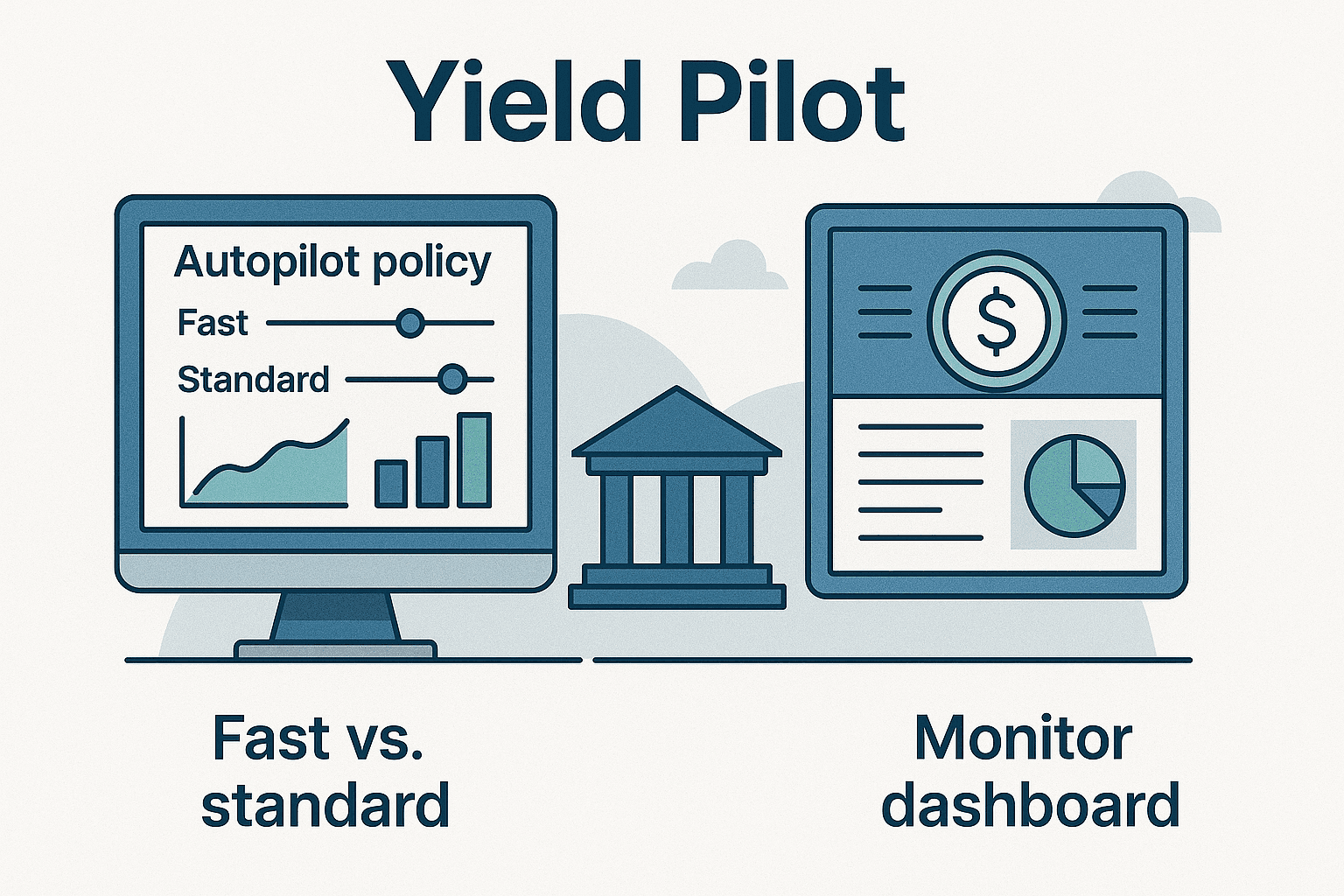
YieldPilot is the product layer built on Pika Vault. It watches settlements, keeps a safety reserve for refunds and bills, puts the rest to work, and—when cash is needed—selects the best payout path:
- Fast (small discount, near-instant)
- Claim (sell queue position if enabled)
- Standard (ETA, FIFO)
Then it drafts the journals accountants expect. Conservative by design; invisible by default.
Promise: fewer decisions, lower idle cash, cleaner books.
The problem with “cash management”
Teams either sit on idle balances or scramble across fragmented venues at the worst times. Refunds spike when liquidity is thin; forecasts live in spreadsheets; accounting trails break.
Most tools add more knobs. Very few remove them.
What YieldPilot does
-
Understands near-term needs
Ingests settlement signals + simple context (refund history, payroll cadence) to maintain a just-in-time reserve. -
Puts surplus to work
Sweeps the remainder into a conservative, RWA-optimized “earn” account powered by Pika Vault. -
Pays out predictably
On withdrawals or refunds, shows three paths—Fast / Claim / Standard—and executes per policy. -
Keeps books clean
Drafts plain-language journals and policy notes accountants can accept without translation.
// Reserve policy example (pseudo):
const targetReserve = max(0.12 * last7dGross, p90(refundsNext24h) + nearTermPayroll)
if (cashOnHand > targetReserve) sweep(cashOnHand - targetReserve)
How it works (flow)
Observe YieldPilot listens to settlement events and aggregates recent history.
Plan It computes a target reserve (e.g., % of last 7 days’ sales or p90 of expected refunds + payroll).
Act If cash exceeds reserve, it sweeps surplus into Pika Vault. If outflows hit, it quotes Fast / Claim / Standard and executes the best path.
Explain It records the decision, posts the journal entries, and updates the dashboard—reserve %, last sweep hash, queue depth, sleeve %, last NAV tick age.
✅ Operator-first surface: no crypto jargon—just balances, timers, and journals.
Why it matters
Fewer decisions — set policy; let the autopilot handle execution
Lower idle cash — keep enough for refunds/payroll; put the rest to work
Predictable exits — choose speed vs price with clear expectations
Audit-friendly — every action has a rationale and a matching journal
A day in the life
Morning: settlements land → policy sets a 12% reserve → surplus swept
Mid-day: large refund arrives → quotes show Fast (120s, small discount) vs Standard (12h ETA)
Action: policy prefers instant resolution → Fast executes
Books: Dr Refunds Expense / Cr Earn Account with discount & rationale attached
Safety & constraints
Respect the reserve — never dip below target without explicit policy change
Transparent limits — max Fast discount, minimum sleeve level, NAV staleness bounds
Idempotent ops — webhook retries won’t double-sweep or double-pay
Separation of concerns — YieldPilot orchestrates; Pika Vault governs asset/exit safety
🧭 Policy over guesswork: everything is explicit and versioned.
Who it’s for
Merchants & platforms — instant refunds; clean month-end
Fintech treasuries — conservative yield with predictable liquidity
Developers — embed “smart cash” without managing chains, bridges, or bespoke vault logic
Looking ahead
Policy simulation — “what if Fast capacity increases during seasonal peaks?”
Dynamic pricing — Fast discount curves tied to sleeve utilization & queue pressure
Attestations — proofs for policy compliance and fee bounds
More connectors — additional commerce & payout platforms
Try it
Start with the sandbox, see the dashboard, trigger a payment, request a withdrawal, and watch YieldPilot plan → act → explain.
🧪 Demo access: request invite
🧩 Integration: webhooks + SDK
📬 Contact: hello@kairic.com